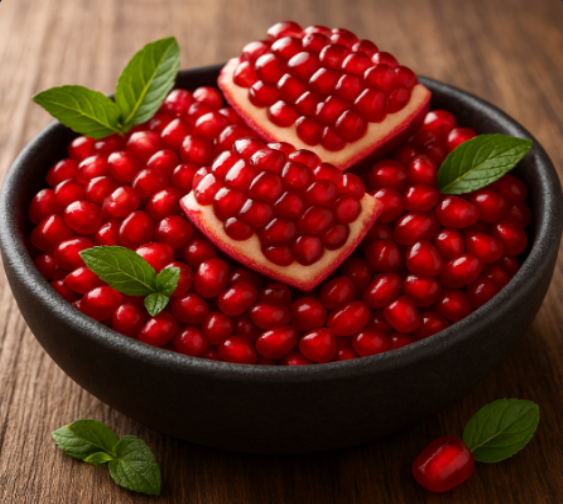
The pomegranate (Punica granatum) is one of the oldest
fruits known to humans; it's deeply embedded in our history.
For thousands of years, it has been a vital provider of food
and medicine across different cultures and civilizations.
- 1. Where
do pomegranates come from?
The genus name given to pomegranates (Punica) came from the
Roman name for Carthage, an ancient city in Northern Africa
The Romans mistakenly assumed pomegranates derived from
Africa.
In fact, pomegranates are considered to have originated from
Iran, south-west Pakistan and parts of Afghanistan.
The pomegranate fruit was also given a classical Latin name,
Malum granatum, meaning "grainy apple".
Pomegranate (Punica granatum) flower
Pomegranate flower, Oliver Whaley © RBG Kew
Pomegranate (Punica granatum) spherical red fruit
Pomegranate fruit, Ibrahimjon © Wikimedia Commons
- 2. What kind of fruit is a pomegranate?
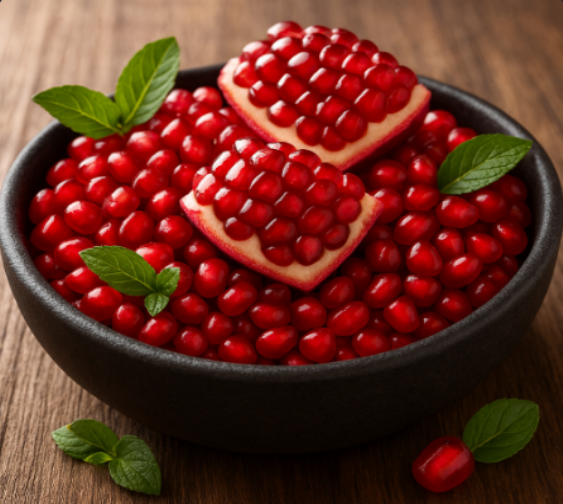
True berries are fleshy fruits that come from a single
flower with one ovary and typically have several seeds.
Pomegranate fruit fall into this group.
The dry outer covering (husk) of pomegranate fruit is made
up of two layers:
- An
outer, hard layer called an epicarp
- An inner, soft layer called a mesocarp
The inner mesocarp forms distinct, non-symmetrical chambers containing seeds with a fleshy covering (aril).
Did you know? Bananas, cucumbers and aubergines are also classified as berries, but strawberries and raspberries are not.
Open pomegranate (Punica granatum) fruit that is spherical
and red with deep red tissue surrounding seeds
Open pomegranate fruit, noa fisher © Wikimedia Commons
- 3. Are pomegranates good for you?
The fruit, flowers, bark, roots and leaves of pomegranates
contain chemicals, such as polyphenols, that can be used to treat a number of
diseases and conditions.
It is rich in vitamin C and folic acid.
Ancient cultures understood the health benefits of
pomegranates and used it in remedies for digestive disorders, skin disorders,
and intestinal parasites, to name a few.
Modern day research has revealed that pomegranates might contribute towards preventing serious conditions such as heart disease, diabetes, and cancer.
Open pomegranate (Punica granatum) fruit that is spherical
and red with deep red tissue surrounding seeds
Open pomegranate fruit, DOP Granada Mollar de Elche ©
Wikimedia Commons
- 4. What do pomegranates symbolise?
In Greek mythology, the pomegranate was known as the ‘fruit
of the dead’ as it was said to have arisen from the blood of Adonis.
It also prominently featured in the myth of Hades and
Persephone.
Hades, God of the underworld, used pomegranate seeds to
trick Persephone into returning to the underworld for a few months of every
year.
Alongside death, the pomegranate symbolised fertility in Ancient Greece and Rome.
It had a strong association to Aphrodite, the Greek goddess of love, as well as Hera, the Greek goddess of marriage and childbirth.
In Ancient Rome, newlywed women wore crowns woven from pomegranate leaves, and the juice of pomegranates was used to cure infertility.
Watercolour of pomegranates (Punica granatum) by Ann
Schweizer
Watercolour of pomegranates (Punica granatum) by Ann
Schweizer © RBG Kew
- 5. Grown in paradise
In the Quran, pomegranates grow in the Garden of Paradise
and are referred to on multiple occasions as God’s good creations.
The pomegranate is also said to be found in the Garden of
Eden according to Ancient Iranian Christianity and was believed to be the real
forbidden fruit rather than the apple.
During the non-Christian Iranian tradition, Yalda Night,
people come together on winter solstice and eat pomegranate fruit to celebrate
the victory of light over darkness.
Look out for the pomegranate, a plant heavily laced in
symbolic history and celebrated to this day for its many nutritious and
medicinal properties, in Kew's Temperate House. Its gorgeous fruits will be on
display right through summer and into spring.
You can also keep an eye out for other pomegranate varieties in the Duke's Garden at Kew.
Credit to:
https://www.kew.org/read-and-watch/surprising-pomegranate-facts/